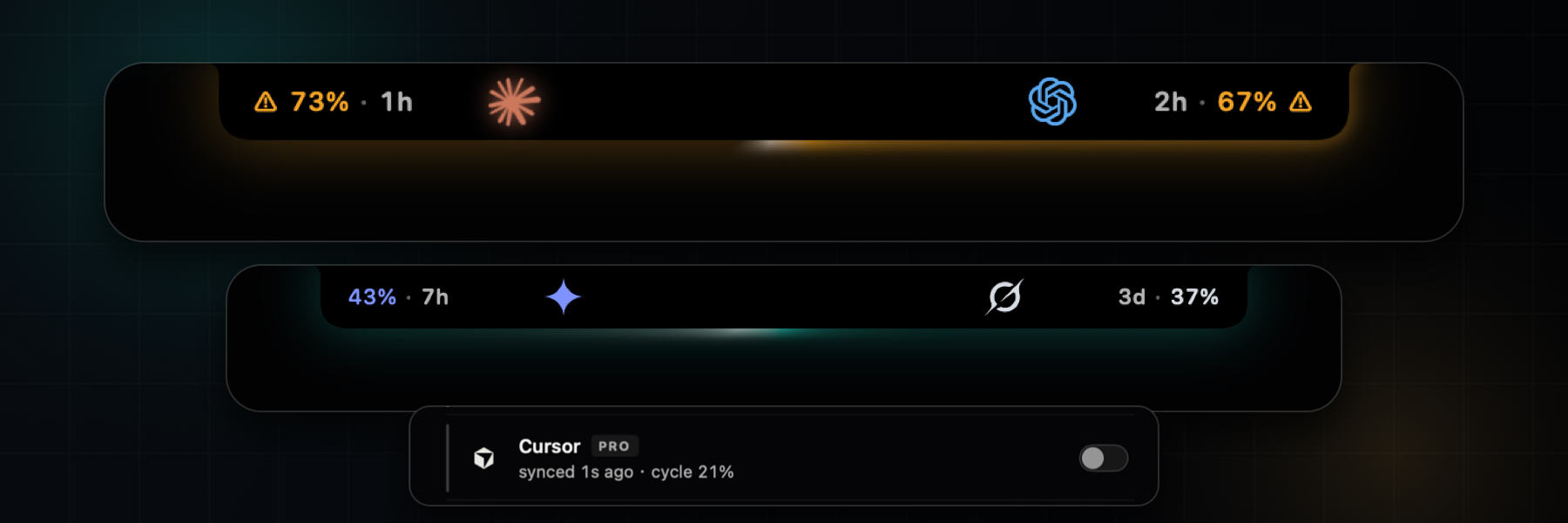
Every provider becomes a full citizen: Cursor gets real your-turn alarms, Antigravity replaces Gemini as the fifth seat, and Windows ships the same five providers from the same tag.
2.1.2: all five providers become full citizens, Antigravity takes the fifth seat, and Windows ships from the same tag as macOS
Added
Cursor becomes a full citizen — live session state and your-turn alarms driven by its own completion signal rather than a timing guess, on top of billing-cycle usage and plan.
Real-time file watching for Grok, Antigravity, and Cursor, so their sessions update without waiting for the next scan tick.
Grok, Antigravity, and Cursor join the cost ledger and the weekly and monthly report cards.
Alarm sounds gain an Apple ringtone tier, with Radar as the new default.
The five-blade mark lands across the app, the DMG, and the Windows icon.
Changed
Antigravity replaces Gemini as the fifth provider. Google retired Gemini Code Assist for individual accounts on 2026-06-18 and pointed those users at Antigravity, so the slot follows the users; a stored Gemini selection migrates automatically.
Antigravity quota is read from the local language server rather than a cloud endpoint, and returning to a session uses agy --conversation to reopen the exact thread.
Windows reaches parity: the same five providers, the same live session state, released from the same tag as macOS.
Report cards drop the rank block, cap the monthly table to the top three models, and price Claude Opus 5 correctly (it was silently counted at zero).
Claude in-app sign-in now requests the exact six scopes the CLI uses, fixing an "Invalid request format" failure.
Fixed
The island could disappear and stay gone — three separate vanish paths are closed, with a self-healing check behind them.
Cursor no longer spins forever without raising your turn, and its turn status no longer freezes on a stale cache snapshot.
Antigravity stopped firing mid-run: tool steps report the same source as the model, so a turn only counts as finished when the planner responds with no pending tool calls.
Guest logins are re-detected properly, and every alarm click now lands somewhere real.
Removed
Auto-resume is gone. Visibility and execution authority stay separate: Agent Island tells you a turn ended and takes you back to the session, but never continues a run on your behalf.
2.1.1
Five providers, richer session awareness, safer sign-in, and a settings system rebuilt around the way people actually operate multiple coding agents.
The 2.1.1 release overview: Claude, Codex, Antigravity, Grok, and Cursor share the same local-first island
Added
Cursor joins the island — billing-cycle usage and plan read locally, beside Claude Code, Codex, Antigravity, and Grok. Five providers, two configurable island slots.
Session status goes island-wide: live working / stalled / your-turn state for Grok and Antigravity, joining Claude and Codex — each driven by the agent's own records.
Codex account switching: park logins under names, swap from the menu, and opt into auto-switch when the active quota runs dry.
Claude sign-in gains a paste-code fallback that appears only when the primary browser round-trip cannot complete.
Weekly and monthly reports accept any start date and list every model that ran.
Changed
The settings panel is rewritten: sidebar navigation, a teal-for-data / gold-for-selection color language, and micro-motion on every control.
Claude sign-in mirrors the official CLI exactly, with a paste-code fallback; Codex re-authentication appears only when credentials actually fail.
The About page now explains the local data boundary directly instead of repeating feature marketing.
Provider selection is explicit: five data sources can be configured while the island keeps two focused top-bar slots.
Removed
The subagent turn-alarm toggle and its scanning path are gone. Child threads no longer compete with the main conversation for attention.
A large craft-and-reliability release: a styled installer, calmer visual modes, better single-provider layouts, dependable updates, and a major accounting correction for long-running Codex sessions.
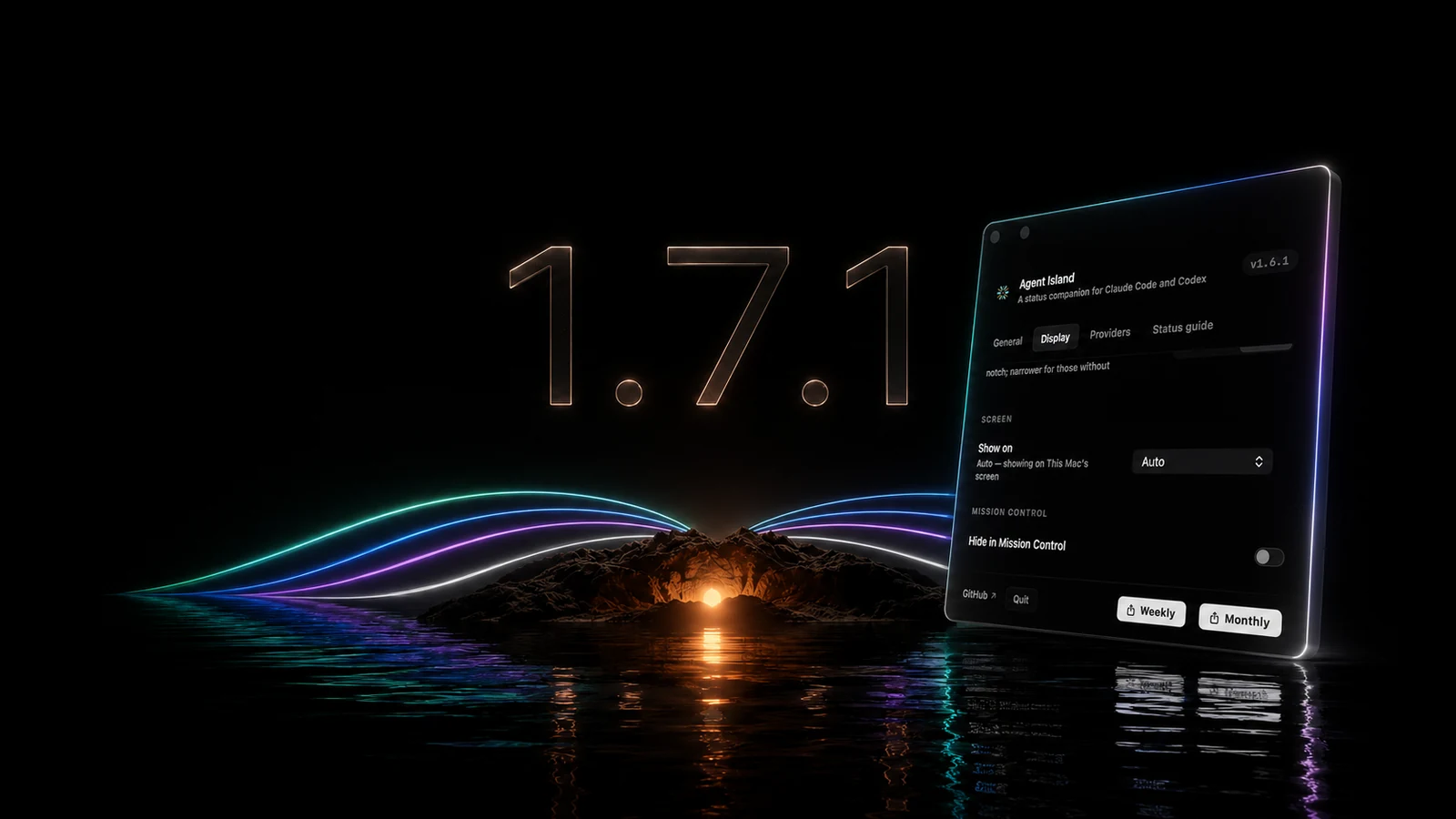
1.7.1: light you can choose — four glow colours sweep from the island behind the settings panel
Added
The DMG opens as a designed installer with the Agent Island mark, a clear drag-to-Applications path, and a dark presentation instead of a bare Finder window.
Report cards v3: a Claude-vs-Codex faction duel at your real usage split, TOP-3/TOP-5 model donuts, and an island-rank finale on a flat dark coat.
Visual modes: Vivid is the new default with a glow color choice (teal, cobalt, violet, silver); Calm turns all ambient light off.
Solo layout for single-subscription machines, both on the island and in the panel.
An update prompt sourced from GitHub releases.
Changed
The your-turn alarm holds while you are looking at the session and fires when you switch away.
Codex accounting now includes archived sessions and drops replayed deltas, so long-lived sessions no longer double-count.
The physical-notch silhouette is shorter and flares into the screen edge, matching the hardware instead of hanging below it as a grey chin.
Report cards and turn alarms now share the same near-black surface, continuous corners, and restrained brand palette.
Interface scale can enlarge the island on external 4K displays while notched MacBooks stay at a hardware-matched 1:1 size.
Fixed
A watchdog prevents the expanded panel from becoming an empty black slab after fast hover transitions.
Classic mouse wheels can change panel pages, Launch at Login recovers from stale registration records, and stalled cost scans escape after ten minutes.
Large Claude log lines and wedged scans no longer create unbounded memory or permanently stale cost data.
The reporting release that turned local token history into weekly and monthly cards, while adapting Agent Island to Codex's move from two quota windows to one weekly window.
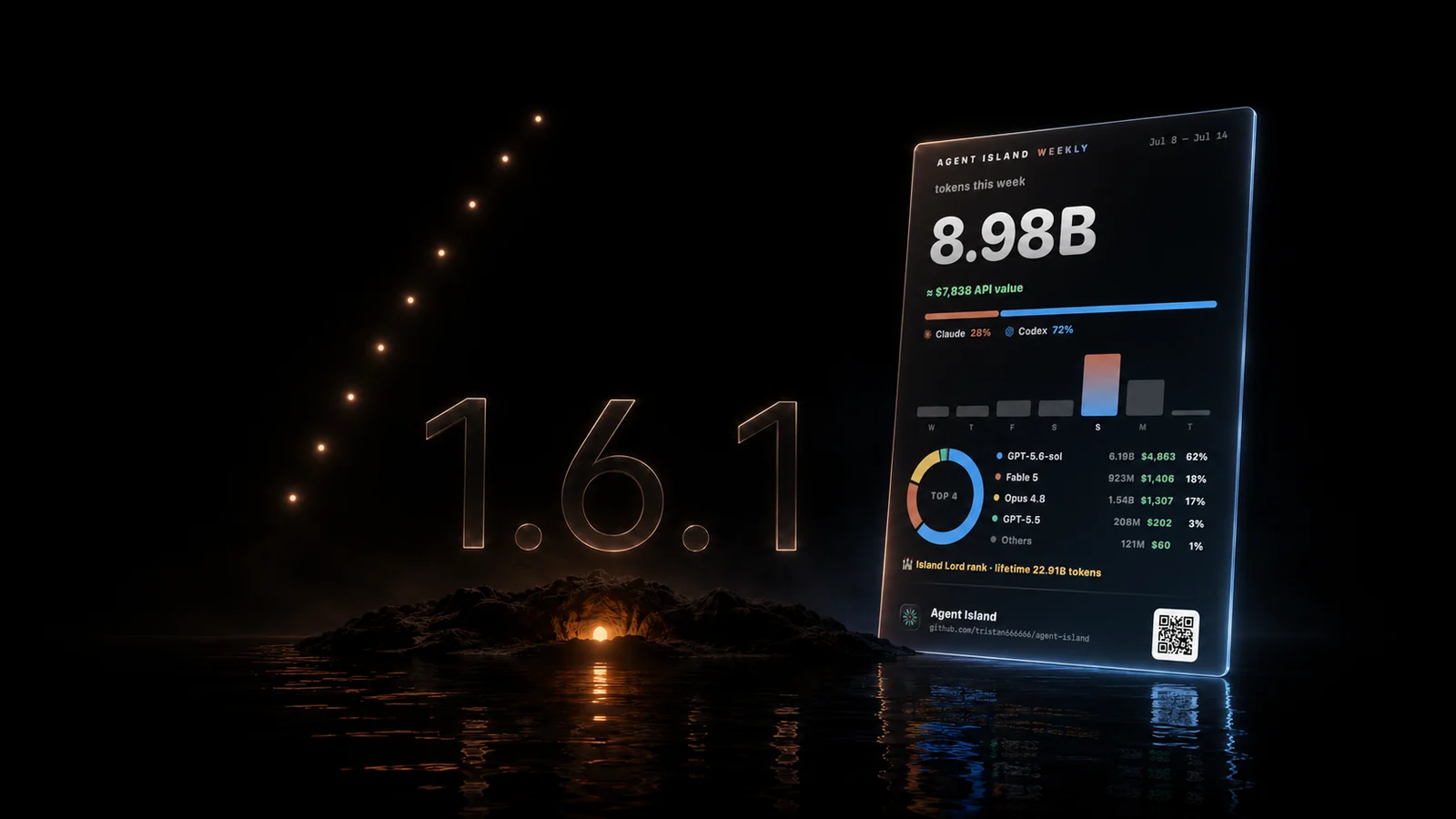
The original 1.6.1 launch cover: reset cards and shareable reports were the release story
Added
Weekly and monthly report cards, island ranks, and a local model/API-value breakdown.
Codex reset cards and better retry behavior for transient usage-network failures.
Reports can be copied as images or shared through the system sheet; the weekly card also greets the user once per ISO week.
Seven lifetime-token ranks range from Drifter at 100M tokens to Legendary Navigator at 100B.
Changed
Codex now follows the provider's single weekly quota window; the retired 5-hour window is no longer displayed.
Model pricing snapshot updated to 2026-07-13. API value remains an estimate, not a subscription bill.
The cost page becomes the default panel page, and its weekly model totals include cache tokens so the rows add up to the shared headline.
Background timers survive a locked screen and refresh immediately after wake without preventing the Mac from sleeping.
Removed
Auto-resume is retired on both platforms. Current builds monitor state and alert the user without continuing a run.
Codex's retired 5-hour alarm and legacy credits display are removed with the old window.
A focused efficiency and alarm-correctness release: quota warnings finally stayed quiet after firing, while the island's signature glow moved off the CPU.
Fixed
Quota alarms re-arm only when a genuinely new reset cycle begins, instead of treating Anthropic's small reset-time drift as a new limit event.
The island's rotating conic glow is shaded once and spun on the GPU, preserving the look while sharply reducing idle CPU and energy use.
Session scans read each file modification time once through a direct system call, removing repeated metadata work from the frequent background scan.
Windows receives the same alarm-off switch as macOS, a softer island glow, and leaner Settings copy.
1.5.6
Updates, alarms, and reset recovery became dependable across both platforms, with fewer duplicate warnings and a much clearer path back into a coding session.
Added
Windows gains one-click Update & Relaunch: download the new zip, replace the running app, and reopen without a manual reinstall.
macOS can disable only the out-of-quota alarm while keeping reset monitoring and auto-resume available.
Claude and Codex each get their own “Open thread” destination, so desktop-app and CLI workflows can be chosen independently.
Fixed
One blocked quota stretch produces one alarm per provider; duplicate panels and the redundant system banner are removed.
Reset crossings refresh usage and trigger authorized resumes automatically, including immediately after sleep or wake.
Auto-resume accepts sessions whose working directory could not be read, and the picker no longer duplicates every thread.
Windows Claude re-authentication, concurrent settings writes, and update-prompt wording are corrected; macOS gains drag navigation in the expanded carousel.
1.5.5
Windows update checks became real, Codex threads opened in the right app first, and quota percentages finally said exactly whether they meant used or remaining.
Added
Windows polls GitHub Releases daily when automatic checks are enabled and presents a download dialog when a newer build exists.
“Check now” distinguishes latest, newer, and unreachable states instead of behaving like a decorative control.
Fixed
Opening a Codex thread now prefers the exact codex://threads/… destination in Codex Desktop, using terminal resume only as fallback.
The quota display control becomes an explicit Used | Remaining choice on both platforms, replacing an ambiguously worded toggle.
1.5.4
Two small display controls made the island fit very different hardware: external monitors on macOS and single-provider setups on Windows.
Added
macOS adds an opt-in “Hide in Mission Control” control for external displays where the Spaces bar sits at the same top edge as the island.
The option stays off by default because notched MacBooks need the island to remain pinned when the Spaces bar drops below the hardware cutout.
Windows folds away the unused side when only one provider is enabled and animates the active logo into the center.
Single-provider centering is on by default, with a Display setting available for people who prefer the original symmetric silhouette.
1.5.3
Usage could be read as capacity left instead of capacity spent, while disabled providers finally stopped influencing attention states and alarms.
Added
Settings → Display can show remaining quota instead of used quota across both macOS and Windows.
The same interpretation applies consistently to expanded usage tiles and compact peek pills.
Opening a Claude Desktop session copies its title to the clipboard, with a quiet macOS confirmation, so it can be found through Claude search.
Fixed
A provider switched off in Settings no longer drives the red attention pulse or fires an out-of-quota alarm because its login is absent.
1.5.2
Thread opening returned to the correct desktop app, the Mac icon was rebuilt for modern system masks, and release automation became strict enough to trust.
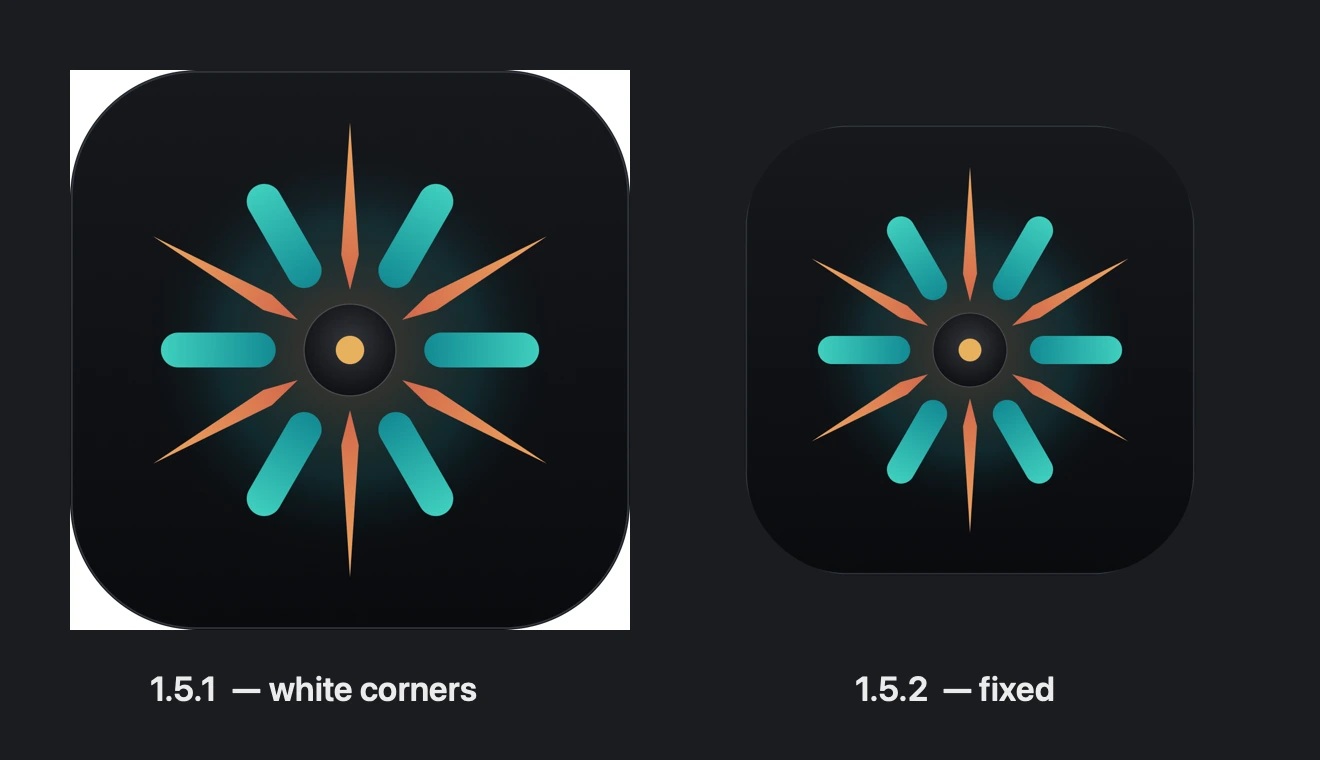
The official 1.5.2 release comparison: the 1.5.1 white-corner icon beside the corrected 1.5.2 icon
Fixed
Claude Desktop sessions bring Claude Desktop forward again instead of opening Terminal; real CLI sessions still resume through claude --resume.
The macOS app icon is rebuilt on Apple's icon grid with transparent margins, removing white corners and unwanted system backing plates.
Release automation reliably extracts notes from the authoritative changelog, and a missing version section now fails the release instead of shipping a stub.
Added
Demo mode can render both alarm-card variants directly to PNG for reproducible release screenshots.
1.5.1
The first version-aligned macOS and Windows release introduced a dedicated quota-exhausted alarm and moved Claude re-authentication out of Terminal.
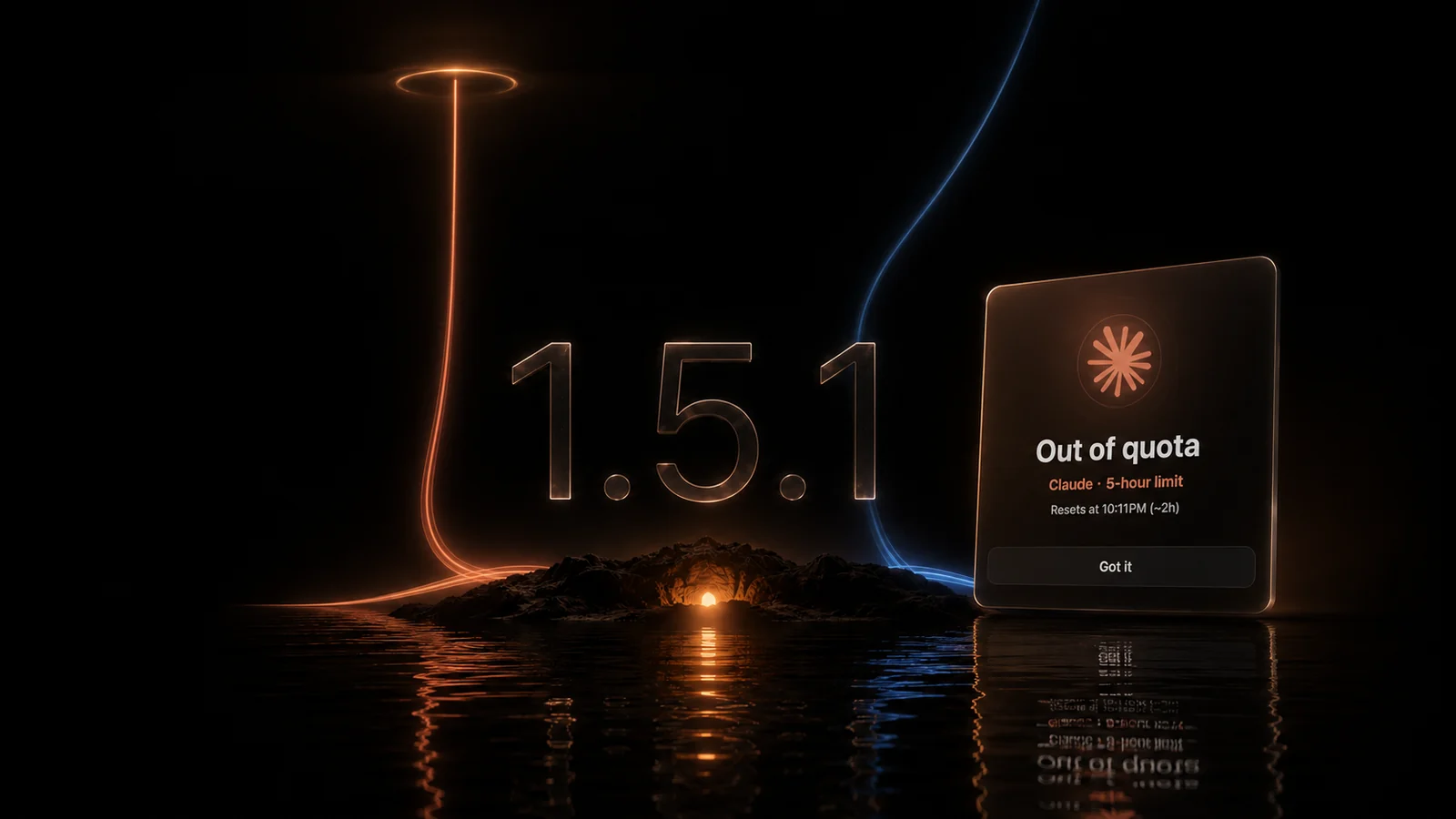
1.5.1: the full-screen alarm that fires the moment a quota window hits 100%, carrying the reset time
Core release
One tag now aligns macOS and Windows on the same version and the same session-detection behavior.
A distinct full-screen alarm appears when a 5-hour or weekly window reaches 100%, with the relevant reset time visible.
The alarm warms up safely on launch, respects the master alarm switch, and fires once per reset cycle.
Claude re-authentication opens the browser authorization flow and completes through a local callback, keeping the CLI path only as fallback.
An “Alarm on subagent threads” setting arrives on both platforms and remains off by default.
1.4.1
A correctness release for people running automations and many agents at once: fewer false alarms, instant language changes, and safer first-run terminal behavior.
Fixed
Codex automation rollouts, probes, orchestrator subagents, and codex exec no longer raise turn alarms or drive the logo.
Forced language now applies everywhere immediately; date formatters no longer freeze the old locale and the misleading restart alert is gone.
Display tab now merges the two "Top bar" sections into one.
Alarm sounds preview on click instead of hover, and resume commands run off the main thread so first-time Terminal permission no longer freezes the app.
Changed
Native English copy now uses "Got it", unified session terminology, and "Show on" for screen choice.
Localization tables were cleaned, with 59 dead keys removed; release CI now runs test suites before building.
The release pipeline promotes automated checks from a local convention to a required step before packaging.
1.3.2
The subagent-storm fix: dozens of child threads can finish together without turning one useful notification into a wall of alarms.
Fixed
Subagent storms no longer queue dozens of alarm popups. Bursts collapse to one alarm for the newest turn, and the rest are recorded silently.
The newest main-thread event wins the visible surface instead of being buried behind older child-thread completions.
Changed
Faster alerts: FSEvents latency 0.2s to 0.05s, scan throttle 1s to 0.5s, confirm buffer 2.5s to 1s. A finished turn now pops its alarm in about 1.2-1.7s.
The faster path still performs a confirmation scan before alerting, preserving reliability while cutting the wait.
1.3.1
The event-driven reliability foundation: turn delivery keys, fresh confirmation scans, queued alarms, and live logo updates tied to actual session changes.
Fixed
Turn alarms are reliable: per-turn delivery keys prevent repeats, Claude Desktop bookkeeping no longer randomly swallows "your turn", confirm re-checks use a fresh scan, and alarms auto-dismiss once you reply.
Alarm window first click acts even when unfocused, Esc closes, minimize was removed, and size is fixed.
A stalled session no longer masks a finished turn; acknowledged turns stop pinning the logo so a running sibling spins again.
Usage API errors no longer silently swallow turn alarms.
Added
Event-driven scanning through FSEvents: logo state changes within about 1 second, and alarms land about 3 seconds after a turn finishes.
Two alarms queue instead of silently replacing each other.
"Open thread" on Claude Desktop sessions deep-links via claude://resume.
Changed
Settings wording now explains width by Mac type and unifies auto-resume naming.
verify.sh smoke launch runs in demo mode so it cannot fire a real resume or touch the keychain.
Multiple simultaneous completions become an ordered queue rather than a last-write-wins popup race.
1.2.x
A multi-release reliability series that made turn state, quota windows, localization, and update delivery stable enough for daily use.
Reliability
Metadata writes no longer resurrect a stale completed turn or repeat a notification that was already acknowledged.
Working, your-turn, and stalled states transition immediately as new session evidence arrives.
Quota reset countdowns and used-versus-remaining percentages stay consistent across the island, expanded panel, and peek pill.
Polish
Alarm controls, localization, and peek-pill spacing were tightened across the sequence instead of waiting for one large redesign.
The Sparkle signing key rotated safely in 1.2.2, and the default update-feed URL was corrected so future builds could actually be discovered.
1.1.0
Authentication and trust became visible product surfaces instead of hidden setup steps.
Added
Claude re-authentication becomes a visible action instead of requiring users to infer that a missing or expired credential caused blank data.
A public security policy documents how issues should be reported and reinforces the local-data boundary.
Product Hunt and curated-list badges connect the project page to its public launch surfaces.
Documentation
Chinese installation guidance explains the expected app location and reduces confusion caused by launching directly from a mounted image or download folder.
Authentication, installation, and discovery links are brought together so setup failures have an explicit next step.
1.0.0
The first public release established the core promise: keep Claude and Codex usage, session state, cost, and reset timing visible without sending local work to another service.
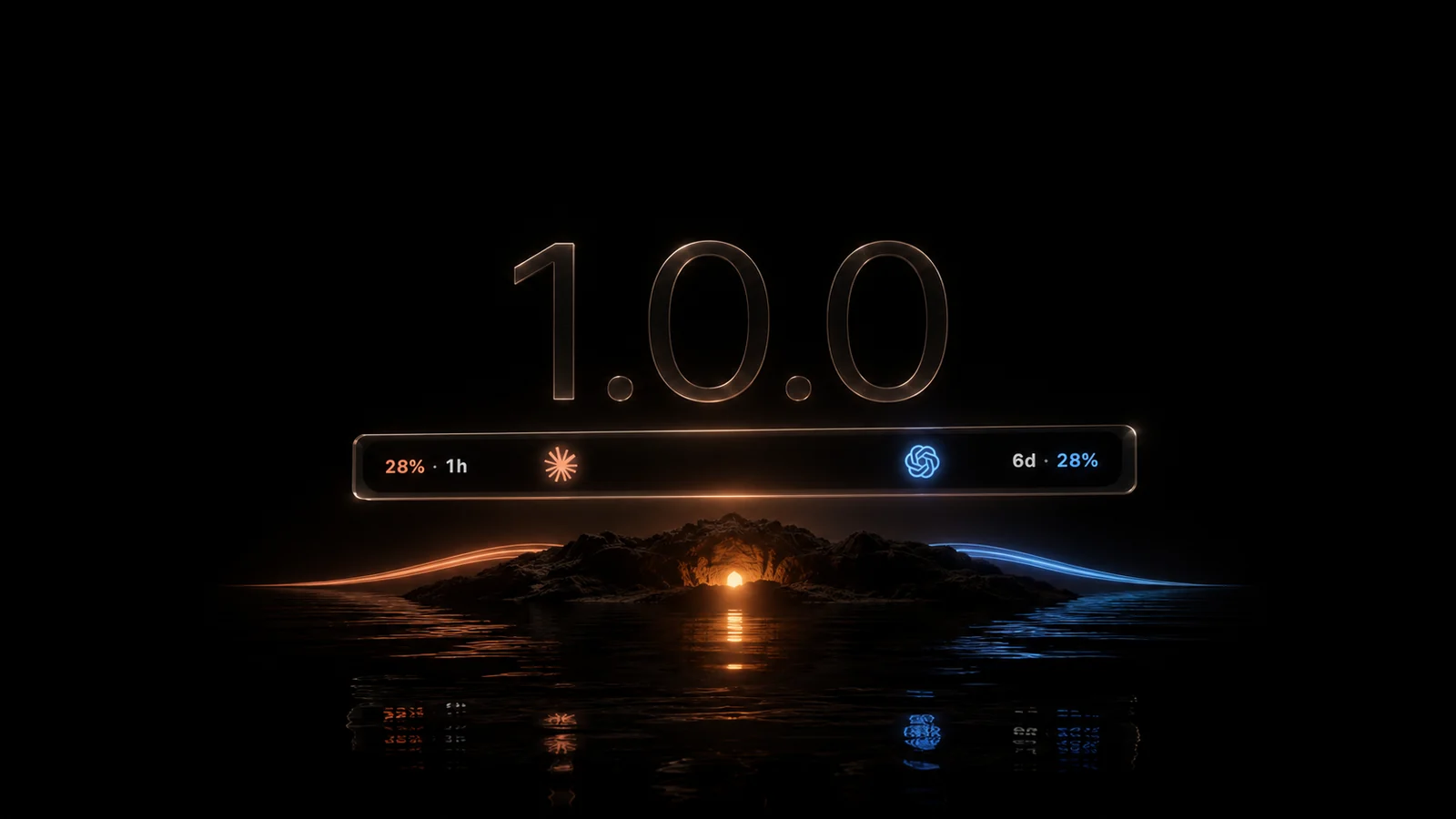
The 1.0.0 release poster from the original GitHub release, showing the first Claude-and-Codex island
Core product
A notch-shaped island shows Claude and Codex usage without keeping a dashboard window open.
The expanded panel combines 5-hour and weekly usage, reset countdowns, local token cost, and provider identity.
Live logos communicate working, your-turn, and stalled states from session records on the machine.
Workflow
Auto-resume could continue selected work after a quota reset, with triggers stored locally.
Demo mode made it possible to film product states without waiting for a real quota or session transition.
English and Chinese interfaces, launch video, and product screenshots shipped together with the public repository.